Montreal
Heated RivalryMontreal is the home city of the Montreal Voyageurs and the setting in which Shane Hollander and Ilya Rozanov’s rivalry acquires its most intimate double meaning. The city holds the public spectacle of their competition and the private spaces Shane uses to keep his sexuality and relationship concealed. It is also one half of a proposed future partnership: Shane imagines working with Ilya for the benefit of Montreal and Ottawa, replacing a story of pure antagonism with one of mutual respect.
Hockey City and Rivalry
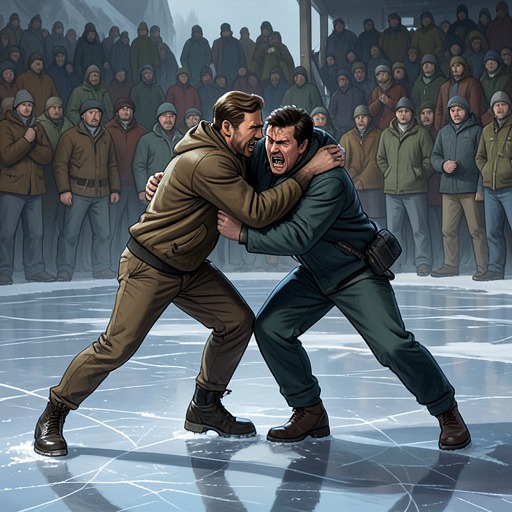
The book places Montreal inside a long-standing hockey rivalry with Boston. The Montreal Voyageurs and the Boston Bears have been opponents for nearly a century, but over the six seasons preceding the October 2016 game, that institutional history has become personified by Shane and Ilya. Fans throughout the arena recognize their antagonism, making Montreal not merely the location of a game but the home audience before whom their rivalry is continually performed.
That performance is sharpened by the 2016 home game. Montreal should have been celebrating a win, but with less than eight minutes remaining the Voyageurs trail Boston 4–1. Shane has already missed five scoring chances, while Ilya has scored twice and helped turn the contest into a humiliation for the home team. At the face-off, Shane bends opposite Ilya as the referee prepares to drop the puck. The scene compresses the city’s two roles: Montreal is Shane’s home ice, where he is expected to succeed, and the stage on which his most personal opponent can make that expectation hurt.
The rivalry also has a media life beyond the rink. After a game, reporters welcome a Shane-versus-Ilya sound bite, and Shane obliges by pointing ahead to their next meeting in Boston. Their antagonism is therefore not only a matter of play; it is a public narrative that journalists and fans recognize and reproduce. Montreal is the place from which that narrative is voiced, even as its private reality remains hidden.
A City of Public Scrutiny and Private Space
For Shane, Montreal is associated with both the promise and the danger of a career in professional hockey. He reasons that rumors about his sexuality would become increasingly difficult to manage as his career advanced. In his view, the NHL’s public claims of inclusiveness did not erase what he had encountered on the ice or in the dressing room: homophobic slurs remained common, and no NHL player had come out publicly. He could imagine the courage such a first player would need, but did not believe he could be that person. His fear is specific to the culture surrounding his work, not simply to private uncertainty about whom he desires.
Against that exposed public world, Shane keeps Shane’s secret Plateau apartment. He spends only a few nights each year there, choosing it when he wants complete privacy rather than going to his Westmount penthouse. The concealed retreat is a small condominium at the top of a three-story building. Shane owns the other two floors as well; the ground floor houses a high-end kitchenware boutique, closed for the night when he arrives. He parks in the small lot behind the building and enters through the back door before climbing upstairs. The route and the empty floors give his privacy a physical arrangement: access is controlled, and the ordinary commercial frontage conceals the secluded residence above.
Montreal also appears in the disciplined routine through which Shane organizes his life. In September 2010, the narrative introduces him as a man of routine: he rises at six for a ten-kilometer run, returns to his new apartment for exercise, then stretches, eats breakfast while watching SportsCenter, and showers. The sequence presents an ordered daily life in the same city where his understanding of his sexuality is becoming harder to keep neatly categorized. Routine offers structure, but it does not resolve the conflict between his private desires and the demands he associates with professional hockey.
The City as a Measure of Secrecy
The importance of Montreal is clearest in Shane’s calculation of what can and cannot be disclosed. He considers abandoning sex with men, finding someone discreet and patient, or allowing what is happening with Ilya to continue. The options are shaped by his fear of rumors and by the belief that Ilya has as much to lose as he does. Montreal is consequently more than a backdrop to a concealed relationship: it is the home setting against which Shane weighs the cost of exposure and the practical possibility of privacy.
The city’s position in that calculation changes as Shane begins to imagine a way to work with, rather than simply against, Ilya. He considers the possibility of playing together in Montreal, then recognizes that the city could not afford both players. His alternative keeps Montreal central without requiring them to share a team: Ilya would play for Ottawa while Shane remained in Montreal, and the two would start a charity benefiting both cities. They could tell the public that working together on a cause important to them had created mutual respect. Their private relationship would remain undisclosed, but the public story of their connection could begin to change.
The plan depends on distance as well as proximity. Shane describes Ottawa and Montreal as two hours apart, close enough for a shared cause and a new public narrative, but still separate hockey cities. Montreal therefore signifies both the home team that sustains the old rivalry and the base from which Shane can propose a different kind of partnership. The plan does not erase their competitive identities; it gives those identities another context in which to be understood.
Montreal Beyond the Apartment
Later, the practical geography of their life together extends beyond Montreal proper. Shane buys a house in Brossard, still close to the team’s practice facility, because he and Ilya believe secrecy will be easier if neither lives in an apartment building. This decision echoes the logic of the Plateau retreat: privacy depends in part on controlling who can approach and observe them. The arrangement changes, from a rarely used concealed condominium to a house selected for an ongoing shared life, but the concern shaping both choices remains the same.
Montreal’s narrative significance rests on that coexistence. It is where Shane’s public identity as a Voyageur and rival to Ilya is most visible, where he fears that discovery could damage the future he is building, and where he can imagine a charitable partnership that alters the meaning of their public feud. The city’s arenas make the rivalry legible to everyone; its hidden rooms and carefully chosen homes shelter what the rivalry cannot reveal.